Nitrile gloves are widely used across healthcare, manufacturing, food handling, and household activities. Their strength, resistance, and reliability make them a dependable choice in settings where protection is required. Yet, as their use grows, discussions around their disadvantages have become more common. These concerns are important to understand because they influence waste management, purchasing decisions, and long-term sustainability goals.
This article outlines the main drawbacks of standard nitrile gloves and presents practical context for each point. It also explains how biodegradable nitrile addresses the biggest environmental issue while maintaining the same performance level expected from premium standard nitrile.
1. Environmental Persistence
The most recognised disadvantage of traditional nitrile gloves is their slow breakdown rate. Standard nitrile can stay in landfills for decades. The material does not readily decompose under common waste conditions. This means large volumes accumulate over time, creating a rising need for improved disposal routes.
This environmental challenge often becomes more visible in sectors that rely heavily on disposable gloves. Hospitals, laboratories, factories, and food-processing sites produce substantial waste every day. Even households contribute to the volume, especially as glove use has increased in recent years.
The persistence of standard nitrile is not a safety risk, but it is a waste-management concern. Organisations now look for ways to manage glove waste responsibly without adding unnecessary strain on landfill space. Incineration is widely used, but it is energy-intensive. Although modern facilities capture emissions and recover energy, the broader conversation around sustainability remains relevant.
This is the “big one” that most users acknowledge. Standard nitrile performs extremely well, but it is not naturally biodegradable. That fact has pushed the industry to look toward responsible alternatives without compromising function.
2. Limited Recycling Access
The next disadvantage is the limited availability of recycling routes. Nitrile gloves can be recycled, but most local recycling programs do not accept them. The reason is simple: contamination, sorting difficulty, and processing requirements make them unsuitable for standard household recycling bins.
Specialised recycling programs exist, but are usually designed for organisations. These programs operate through dedicated collection boxes. The gloves are gathered, cleaned, shredded, and turned into other products. Flooring materials, park equipment, and durable industrial goods are common outputs.
The limitation lies in accessibility. Many regions still lack convenient collection points. Smaller businesses may struggle with service fees. Households also have limited options. As a result, most users still rely on general waste disposal.
3. Slightly Higher Cost for Biodegradable Options
Cost is another point often raised during procurement. Standard nitrile gloves are available in a wide range of prices. Some low-cost products appeal to budget-focused buyers, especially for tasks that require high quantities.
Biodegradable nitrile gloves tend to cost slightly more than the lowest-priced standard options. The difference is small but noticeable in bulk orders. However, this pricing shift is linked to the materials and technology required to support accelerated breakdown in landfill environments.
It is worth noting that biodegradable nitrile is not intended to compete with the cheapest gloves on the market. These gloves are made to match the performance of premium standard nitrile. Their value lies in long-term sustainability and responsible waste reduction rather than short-term budget cuts.
Even with this minor cost difference, many organisations choose biodegradable nitrile because it reduces environmental impact without compromising protection. The decision comes down to priorities. Some buyers prefer short-term savings. Others prefer solutions that support sustainability goals.
4. The Need for Correct Disposal Protocols
Another practical disadvantage is the need to follow proper disposal rules. The glove itself is not the challenge; the context in which it is used determines the disposal route. A glove used for food preparation is different from one used in a medical setting.
Healthcare, laboratory, and chemical environments require specific disposal procedures. Used gloves in these settings fall under clinical or hazardous waste. They must be placed in designated bags or containers and handled by licensed services. This is standard practice, but it adds steps that some organisations may overlook without structured training.
For general household use, disposal is simpler. The glove goes into general waste unless a local recycling program accepts it. The challenge arises when people assume all gloves can be recycled in household bins, which causes contamination in recycling streams.
Clear instructions and basic staff training solve most of these issues. Proper disposal protects people, supports regulatory compliance, and reduces waste-handling errors.
5. Perceived Differences in Comfort
Historically, early nitrile gloves were stiffer than latex, which created an impression that they lacked comfort. While modern nitrile is far more flexible, the old perception still appears in some user feedback.
Premium nitrile gloves today offer strong tactile sensitivity, good stretch, and consistent fit. Biodegradable nitrile, in particular, matches the feel of high-grade standard nitrile. There is no stiffness or compromise in touch accuracy.
Still, perceptions take time to shift. Some users continue to assume nitrile feels less natural, even though current materials provide excellent comfort for extended wear.
How Biodegradable Nitrile Solves the Biggest Disadvantage
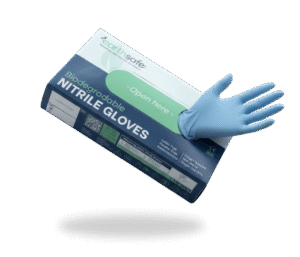
The main disadvantage of standard nitrile is its slow breakdown in landfills. To address this issue, modern biodegradable nitrile technology accelerates the decomposition process when exposed to landfill conditions. This results in substantial reductions in long-term waste accumulation.
Earth Safe BDG nitrile gloves biodegrade up to 90% in 490 days under landfill conditions. This performance change does not affect their strength, durability, or chemical resistance. Tactile sensitivity remains the same as premium standard nitrile. Shelf-life also remains stable and reliable. These points are important because buyers often ask if biodegradable materials compromise longevity or protection. In this case, they do not.
The gloves behave exactly like high-grade nitrile during use. The difference appears only at the end of their lifecycle, where the material responds to microbial activity in landfill environments. This provides a responsible waste option for organisations without changing workflows or handling procedures.
As biodegradable nitrile becomes more accessible, many users recognise it as a practical balance between performance and environmental responsibility. It answers the key concern around landfill persistence while maintaining the qualities that make nitrile dependable.
Demand for better waste solutions will continue. More organisations are reviewing their glove usage through sustainability frameworks. Recycling programs are expanding. Manufacturers are researching new materials. These changes reflect broader awareness around responsible consumption.
Buyers now compare not only price and performance but also the long-term impact of the products they use. Biodegradable nitrile offers a straightforward improvement. It retains the protective qualities users expect and contributes to more responsible waste outcomes.
Upgrade your operation confidently! Our FDA-compliant biodegradable nitrile gloves deliver the protection and assurance you need to meet the highest food safety standards, all while providing a simple, positive step toward sustainability. Contact our sales team immediately for verified product certifications and bulk pricing: Call +44 7482 212945 or visit our contact page.