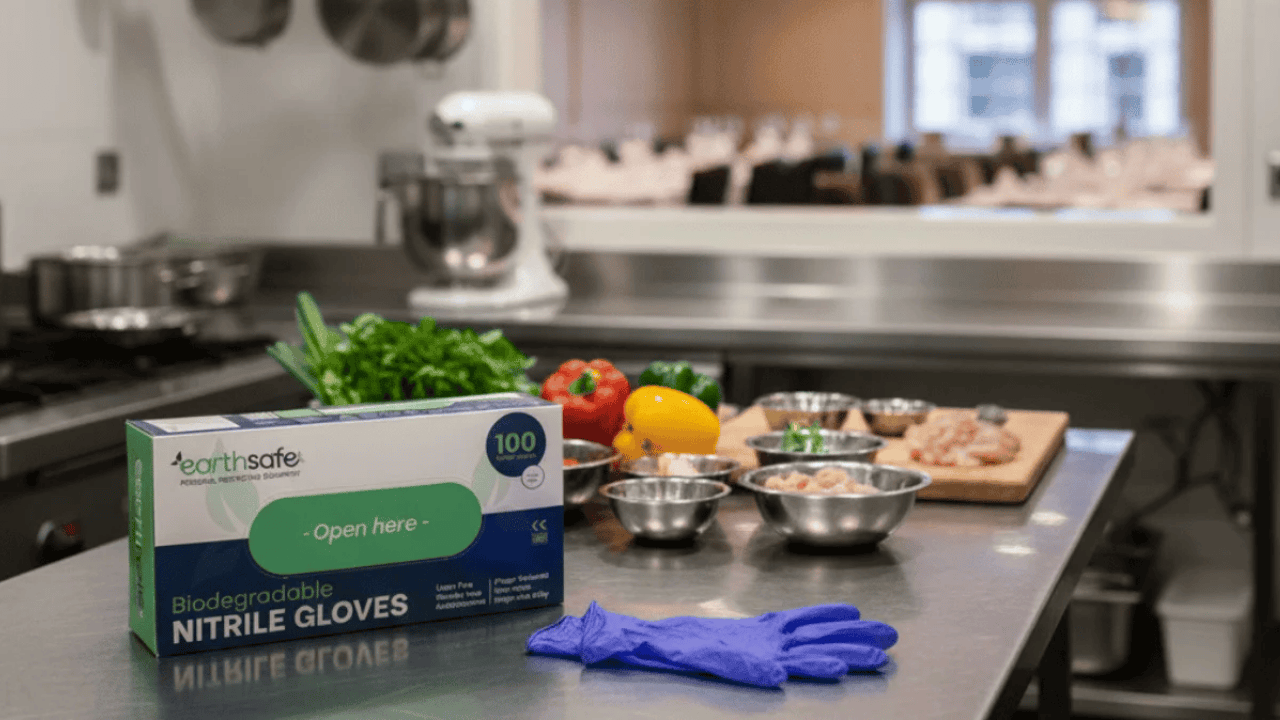
Food service operations run on consistency. Every shift, staff members change gloves dozens of times. Across a chain with hundreds of locations, that adds up to millions of pairs each year. The question facing procurement managers today is not simply which glove to buy, but how to source one that meets food safety requirements while reducing environmental liability.
Sustainable sourcing is no longer a preference. It has become an operational expectation shaped by regulatory movement, consumer awareness, and corporate sustainability commitments. Getting the decision right at the procurement level matters more than most organisations currently acknowledge.
The Scale of the Problem
Global disposable glove consumption exceeds 150 billion units annually. Food service accounts for a significant portion of that volume. Standard nitrile gloves do not break down quickly in landfill conditions. Discarded pairs can persist for decades, contributing to plastic accumulation and microplastic runoff into water systems.
Large chains like Chipotle have begun piloting closed-loop programs to convert used gloves into secondary materials. These efforts reflect a broader direction. Enterprises with strong ESG reporting obligations are under increasing pressure to demonstrate that single-use PPE is being managed responsibly, not simply disposed of.
The pressure is practical as well as reputational. Plastic restrictions are expanding across multiple jurisdictions. Procurement decisions made today will need to hold up against tighter rules in the near future.
Why Standard Nitrile Is No Longer Sufficient
Standard nitrile gloves remain the dominant choice in food service due to their chemical resistance and latex-free composition. For workers with latex sensitivities, they are a practical requirement.
The problem is their end-of-life performance. A conventional nitrile glove offers strong in-use durability but contributes to landfill accumulation once discarded. For operations generating high volumes of waste daily, that liability compounds fast.
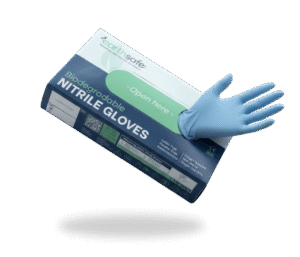
Biodegradable nitrile addresses this without asking operations to sacrifice protection. The material retains the puncture resistance and chemical barrier properties that food service demands. The difference lies in what happens after disposal. Gloves engineered with accelerated breakdown technology can biodegrade up to 90% within 490 days under standard landfill conditions, depending on temperature, moisture levels, and microbial activity present at the site.
That represents a significant improvement over conventional alternatives, without requiring changes to how staff handle or wear the product.
What B2B Buyers Get Wrong About Sustainable Gloves
Many procurement managers approach sustainable gloves with reasonable caution. Experience with thinner, lower-quality alternatives has created scepticism. Early biodegradable products in the market were sometimes associated with reduced durability, tearing more readily in greasy or high-heat kitchen conditions, and increasing replacement frequency.
This concern is legitimate but no longer uniformly applicable. Glove manufacturing has advanced. The relevant question now is not whether a sustainable glove can perform adequately, but whether the supplier can demonstrate it meets verified food-grade standards and has the supply consistency to support bulk operations.
Certification verification is where many bulk buyers lose time. Labels claiming biodegradability vary widely in what they actually mean. Some require industrial composting conditions that are rarely accessible. Others break down only under specific moisture and temperature thresholds. Procurement teams should request documentation confirming compliance with food safety regulations and biodegradability testing standards before committing to volume orders.
Supply Chain Stability at Scale
Sourcing sustainable gloves in bulk introduces supply chain considerations that standard procurement processes may underestimate.
Import tariffs on nitrile gloves have risen substantially in recent years, with some levies reaching 25 to 50 percent on products originating from certain regions. Wholesale prices have spiked as high as 170 percent above baseline during periods of supply disruption. For enterprises ordering at scale, these fluctuations can cause significant budgeting problems.
Mitigating this requires working with suppliers who hold documented inventory buffers and can provide reliable lead time commitments. A single-source arrangement with a supplier offering verified stock availability is preferable to splitting orders across multiple vendors with inconsistent quality controls.
Earth Safe PPE was established to address exactly this operational gap. Founded by Peter and Jakub, professionals with nearly two decades of combined experience across Environmental Health and Safety and construction supply, the company was built around the observation that sustainable PPE options were either unavailable at a meaningful scale or failed to match the compliance standards that enterprise buyers require. That background informs how they approach bulk supply relationships: with an emphasis on documentation, reliability, and direct accountability to the businesses they serve.
Storage and Shelf Life Considerations
Biodegradable gloves require controlled storage conditions to maintain product integrity before use. Excess heat and humidity can trigger the breakdown process prematurely, reducing effectiveness and creating unnecessary waste before the gloves even reach the floor.
Bulk buyers should confirm storage specifications with their supplier before placing large orders. Warehousing arrangements that account for temperature and moisture control will protect product quality across longer inventory cycles. This is a practical detail that procurement teams sometimes overlook when focusing exclusively on unit price.
Ordering quantities should reflect realistic consumption rates rather than maximum capacity. Over-ordering creates storage and degradation risk. Under-ordering leads to shortages and potential non-compliance during inspections. Working with a supplier who can model usage patterns and recommend appropriate order volumes removes much of that guesswork.
Making the Business Case Internally
Biodegradable gloves typically carry a higher unit cost than conventional alternatives. That differential is real. Making the case internally requires framing the decision in terms that go beyond per-box price.
Waste management costs are one factor. Operations generating large glove waste volumes often incur disposal fees that can be partially offset by reduced landfill contributions. Some suppliers offer take-back or recycling arrangements that further lower net disposal costs.
Brand value is another. Enterprises targeting consumers who factor environmental practice into purchasing decisions can reference sustainable procurement commitments in public reporting and marketing. This is increasingly relevant to B2B relationships as well, where corporate clients assess suppliers on ESG performance.
Regulatory risk is the third element. Operations that delay transitioning to compliant, sustainable products may face disruption when legislative requirements tighten. Getting ahead of that curve is a low-friction way to protect supply chain continuity.
Selecting the Right Supplier
Procurement managers sourcing sustainable food service gloves at enterprise scale should apply straightforward criteria.
The supplier should hold verified FDA compliance documentation for food-grade use. Biodegradability claims should be supported by third-party testing data, not just marketing language. Bulk pricing should be transparent, with clear terms for minimum order quantities and lead times. References from comparable operations provide a useful signal on delivery consistency and product performance.
Earth Safe PPE works directly with businesses managing high-volume glove consumption. Their biodegradable nitrile glove is a single product, assessed against food safety standards, and supplied with the certifications that enterprise buyers need for compliance records. Managing Director of S Tyres, Eamonn O’Keeffe, noted that after trialling the product on-site, it met operational requirements and supported environmental goals, a straightforward result that bulk buyers should expect from any credible supplier.
Upgrade your operation confidently! Our FDA-compliant biodegradable nitrile gloves deliver the protection and assurance you need to meet the highest food safety standards, all while providing a simple, positive step toward sustainability. Contact our sales team immediately for verified product certifications and bulk pricing: Call +44 7482 212945 or visit our contact page.