Running food service operations across dozens or hundreds of sites is an exercise in controlled repetition. The menu may vary by region, the staff will certainly turn over, but the safety standards must hold. Gloves sit at the centre of that challenge, small, disposable, and surprisingly difficult to get right at scale.
For procurement managers and operations leads, standardizing a single glove across a multi-site chain is not as straightforward as it sounds.
Why Standardization Matters
A chain operating 50, 100, or 300 locations cannot afford inconsistency in food safety protocols. When glove selection is left to individual site managers, the result is a patchwork of products with different materials, thicknesses, and quality levels. That creates compliance gaps, complicates supplier relationships, and makes staff training unnecessarily difficult.
Standardizing one glove type simplifies ordering, reduces inventory variety, and speeds up onboarding. New staff learn one protocol, not five. Bulk purchasing across locations unlocks volume pricing that site-level buying cannot reach.
For a business generating over £1 million in revenue, those savings accumulate quickly.
The Problem with Low-Grade Options
Many chains default to vinyl or polyethylene gloves because they are cheap. The cost-per-unit looks attractive in isolation. The bigger picture is less flattering.
Failure rates for vinyl and polyethylene gloves can reach 50 to 61 percent for leaks, even in unused product. For food-contact applications, that is a meaningful risk. Without formal acceptable quality levels for food-service gloves, unlike medical-grade products, procurement teams are often buying blind to quality.
Nitrile offers a clear improvement. The material is puncture-resistant, chemical-tolerant, and allergen-free. It holds up across tasks, from food preparation to surface cleaning. A single nitrile glove can cover more of what a food service worker does in a shift, which reduces the number of glove changes needed and the opportunity for cross-contamination during transitions.
Compliance Across Jurisdictions
Multi-site chains operating across regions face a further complication. Food safety regulations are not uniform. Health codes differ between local authorities, and glove requirements shift accordingly. Some jurisdictions require gloves for all ready-to-eat food handling. Others place greater weight on handwashing protocols.
This regulatory patchwork can lead to confusion during rollout and inconsistency during inspections. Selecting a glove that meets the highest applicable standard removes the need to manage multiple product versions across different regions. FDA-compliant nitrile gloves provide a reliable baseline that holds up in the most stringent inspection environments.
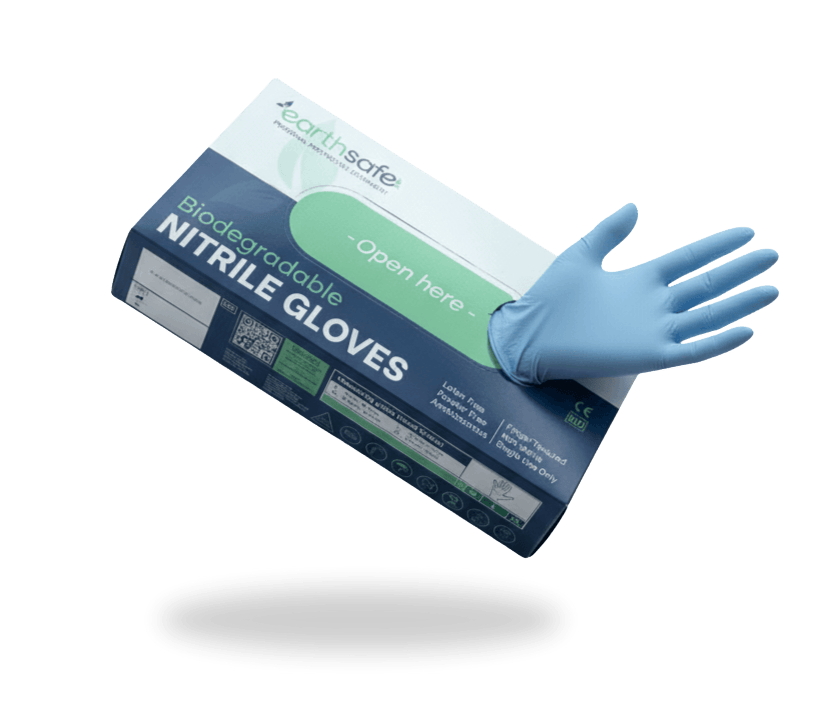
Earth Safe PPE’s biodegradable nitrile gloves carry FDA compliance, giving operations teams a defensible, verifiable position when audits arise.
The Complacency Problem
Standardizing the right glove is only part of the equation. How staff use gloves matters just as much.
Research has shown that gloved hands can carry higher contamination rates than bare hands when workers wear the same pair across multiple tasks. Touching a phone, handling money, or picking something off the floor, then continuing food preparation without changing gloves, introduces a risk that the glove itself cannot prevent.
This is a training and culture issue, not a product issue. But it means the chosen glove must support proper usage rather than complicate it. A well-fitting, comfortable glove is more likely to be changed frequently. Ill-fitting or uncomfortable gloves lead to shortcuts.
For high-turnover environments and restaurant chains that see significant staff rotation, the training overhead of glove protocols is real. A single standardized product makes that training easier to deliver and monitor consistently.
Sustainability as an Operational Consideration
Disposal volume is a direct function of scale. A chain running 150 sites, each going through hundreds of gloves per day, produces significant waste. That waste is increasingly visible to customers, to regulators, and to corporate ESG teams.
Standard nitrile gloves can persist in a landfill for decades. For chains with sustainability commitments in their annual reporting, that sits uncomfortably alongside operational reality.
Biodegradable nitrile addresses this without asking operations to compromise. Earth Safe PPE’s gloves break down up to 90 percent within 490 days under landfill conditions, a marked departure from conventional nitrile, which shows minimal degradation over the same period. The protection profile remains the same. The end-of-life impact does not.
Peter and Jakub, the co-founders of Earth Safe PPE, built the business specifically to close the gap between safety performance and environmental responsibility. With nearly two decades of combined experience in Environmental Health and Safety and construction supply, they understood where conventional PPE was failing. That background shapes how the product is positioned: not as a niche sustainability product, but as operationally viable protection that happens to reduce waste.
Building a Defensible Standard
For a procurement manager making a chain-wide decision, the selected glove needs to clear several bars simultaneously. It must be compliant. It must perform across diverse tasks. It must support training and staff compliance. It must hold up under supplier scrutiny and cost modelling. And it must align with the organisation’s environmental commitments.
Biodegradable nitrile meets those requirements without requiring separate products for separate purposes. One SKU. One supplier relationship. One training protocol.
That is the operational logic of standardization, and it is why glove selection deserves more scrutiny than it typically receives.
Upgrade your operation confidently! Our FDA-compliant biodegradable nitrile gloves deliver the protection and assurance you need to meet the highest food safety standards, all while providing a simple, positive step toward sustainability. Contact our sales team immediately for verified product certifications and bulk pricing: Call +44 7482 212945 or visit our contact page.