Biodegradable gloves are gaining attention as organizations work to cut waste without sacrificing safety. Their rapid breakdown in active landfill environments offers a meaningful step for businesses with sustainability targets, but one question remains common: do these gloves meet OSHA and ISO requirements in the same way as traditional nitrile?
This discussion matters because compliance governs whether a glove can be used in regulated sectors such as laboratories, food production, industrial manufacturing, healthcare support areas, and controlled facilities. A sustainable product must still follow strict rules for protection, performance, and reliability.
The following sections examine how biodegradable nitrile gloves fit into established standards. Each area is explained clearly so businesses can judge whether these gloves offer both environmental and regulatory confidence.
Understanding What OSHA Expects
OSHA does not certify gloves directly. Instead, the agency sets workplace safety obligations and refers employers to suitable protective equipment that matches identified hazards. When gloves are required, OSHA expects employers to select products that provide the right barrier strength, durability, and chemical resistance based on a documented assessment.
Biodegradable nitrile gloves fall under the same expectations as standard nitrile. The fact that a glove biodegrades in landfill conditions does not affect its performance during use. Its structural behaviour must still comply with recognised test methods, performance levels, and glove-specific benchmarks.
OSHA’s references point industries toward established standards used to judge mechanical and chemical resistance. As long as a glove meets these specifications, the glove is considered acceptable for workplace use.
The Role of ISO Standards in Glove Compliance
ISO standards help define technical requirements for disposable gloves. Manufacturers rely on these documents to classify performance, determine acceptable daily limits, and verify ongoing production quality.
Biodegradable nitrile gloves follow the same ISO testing path as conventional nitrile. Their landfill-breakdown properties activate only when exposed to microbial activity, moisture, and conditions found in disposal environments. During use, they behave like standard nitrile because the additives remain dormant until discarded.
Key ISO benchmarks include:
ISO 11193-1: Requirements for single-use medical gloves.
ISO 18889: Performance testing for protective gloves.
ISO 2859: Sampling procedures to check quality consistency.
ISO 10993 (selected parts): Guidelines for biocompatibility when gloves are intended for medical or skin-contact settings.
A biodegradable glove must pass these tests in the same manner as its traditional counterpart. This is what determines whether a glove can be positioned for healthcare, food processing, clean manufacturing, or controlled handling tasks.
How Biodegradability Complements Compliance Instead of Interfering with It
Some buyers assume that a glove designed to break down in landfill conditions may weaken faster during storage or use. This concern is understandable, but modern biodegradable formulations avoid this issue through controlled-activation additives.
These additives remain inactive until the glove reaches the type of environment that contains microbes capable of triggering the breakdown process. In typical workplace conditions, with dry, stable, sealed packaging and indoor storage, there is no premature degradation. The glove functions as standard nitrile during its intended lifespan.
This allows manufacturers to test biodegradable gloves against the same tensile strength, puncture resistance, and barrier-integrity benchmarks used for regular nitrile. Performance requirements remain uncompromised.
Testing That Verifies Compliance
Manufacturers follow a defined sequence of tests before marketing biodegradable gloves for regulated use.
1. Tensile and Force-at-Break Testing
These measurements show how well the glove stretches before tearing. They also reflect whether the glove can tolerate routine workplace movements without unexpected failure.
2. Pinhole and Water-Tightness Testing
Also known as AQL testing, this verifies whether the glove has microscopic defects. Barrier reliability is a crucial requirement for many industries, including food processing, laboratory work, and medical handling.
3. Chemical Resistance Testing
Where chemical exposure is possible, gloves must be graded against defined substances. Biodegradable nitrile is tested using the same chemical-permeation methods as standard nitrile.
4. Biocompatibility Testing
Skin-contact safety is confirmed through irritation, sensitisation, and cytotoxicity assessments, particularly for gloves intended for medical or diagnostic tasks.
5. Manufacturing Quality Audits
ISO sampling plans and production inspections demonstrate consistency across batches. Buyers should request these documents when validating suppliers.
Through this testing combination, biodegradable gloves present clear evidence that their environmental advantages do not compromise compliance requirements.
OSHA Expectations for Food Industry Settings
Food manufacturers and kitchens operate under hygiene and contamination-control rules that require gloves to meet specific safety standards. OSHA references state and national food codes that expect gloves to serve as an effective barrier against contamination.
Biodegradable nitrile gloves follow the same criteria:
- No powder that may contaminate food surfaces
- Sufficient durability to prevent tearing during handling
- Approved materials that remain safe for food contact
- Adequate tactile performance for tasks requiring precision
If a biodegradable glove is FDA-compliant for food contact, it fits OSHA’s expectations for use in food production environments.
How ISO Supports Food-Safe Performance
ISO testing ensures manufacturers demonstrate stable, safe material composition. For gloves intended for food contact, suppliers typically perform migration testing and provide declarations of compliance.
For biodegradable nitrile, this process remains unchanged. The biodegradation mechanism is unrelated to food exposure and activates only after disposal in suitable environments.
This means that businesses can treat biodegradable gloves as direct replacements for traditional nitrile without needing separate processes or procedures.
Storage and Shelf-Life Considerations
Because biodegradable gloves are engineered with additives that activate only under certain conditions, proper storage keeps them stable.
Manufacturers specify conditions such as:
- Store in a cool, dry location
- Avoid sunlight or direct heat exposure
- Keep boxes sealed until needed
Under these conditions, biodegradable nitrile experiences no premature breakdown. Shelf life is comparable to standard nitrile and typically ranges from three to five years, depending on the formulation and storage environment.
With proper rotation, businesses can maintain compliance without difficulty.
ISO Certifications Worth Requesting From Suppliers
Organisations that require documentation for audits or compliance checks should request the following:
- ISO 9001 certification for quality-management processes
- ISO 13485 certification where medical-grade production applies
- ISO test reports for tensile strength, elongation, chemical resistance, and pinhole AQL results
- Skin-contact safety testing for gloves entering healthcare or laboratory sectors
Biodegradable manufacturers offering well-developed products will be able to provide these documents promptly.
Comparing Biodegradable Nitrile to Traditional Nitrile in Regulated Settings
Biodegradable nitrile performs like standard nitrile in terms of:
- Strength
- Elasticity
- Puncture resistance
- Chemical resistance
- Grip
- Fit
- Shelf life
Any differences lie in disposal outcomes, not functional behaviour. Biodegradable gloves break down far faster in landfill conditions, but they must maintain their protective qualities during use.
Because biodegradable options follow identical testing requirements, organisations can adopt them without altering their workflow, training protocols, or safety procedures.
Compatibility With Audits and Certification Programs
Facilities undergoing audits, whether for ISO accreditation, internal safety checks, or customer compliance, often require evidence that gloves are sourced from reputable suppliers and tested using recognised standards.
Biodegradable gloves integrate into existing audit trails because test reports, declarations, and manufacturing certificates match what auditors expect.
This allows businesses to document sustainability improvements without sacrificing clarity or compliance during inspections.
Why Compliance Documentation Matters More Than Marketing Claims
Buyers should look beyond environmental claims and examine the actual test results. Compliance is proven only through recognised standards and third-party testing.
Reliable manufacturers provide:
- Product technical sheets
- Comprehensive testing records
- Lot-traceability information
- Material-safety documentation
- Certifications issued by accredited bodies
A glove’s biodegradable properties should never replace safety validation. Instead, biodegradability should act as an environmentally positive characteristic that sits alongside fully verified performance data.
Sustainability and Regulatory Reliability Can Work Together
The growth of biodegradable glove technology shows that sustainability and compliance need not conflict. Businesses can maintain protection levels while reducing long-term plastic accumulation in landfills. This alignment allows operations to modernise their waste strategies without altering safety protocols.
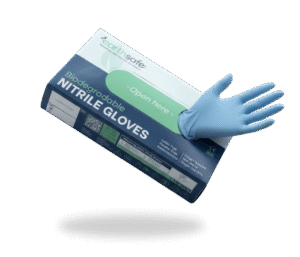
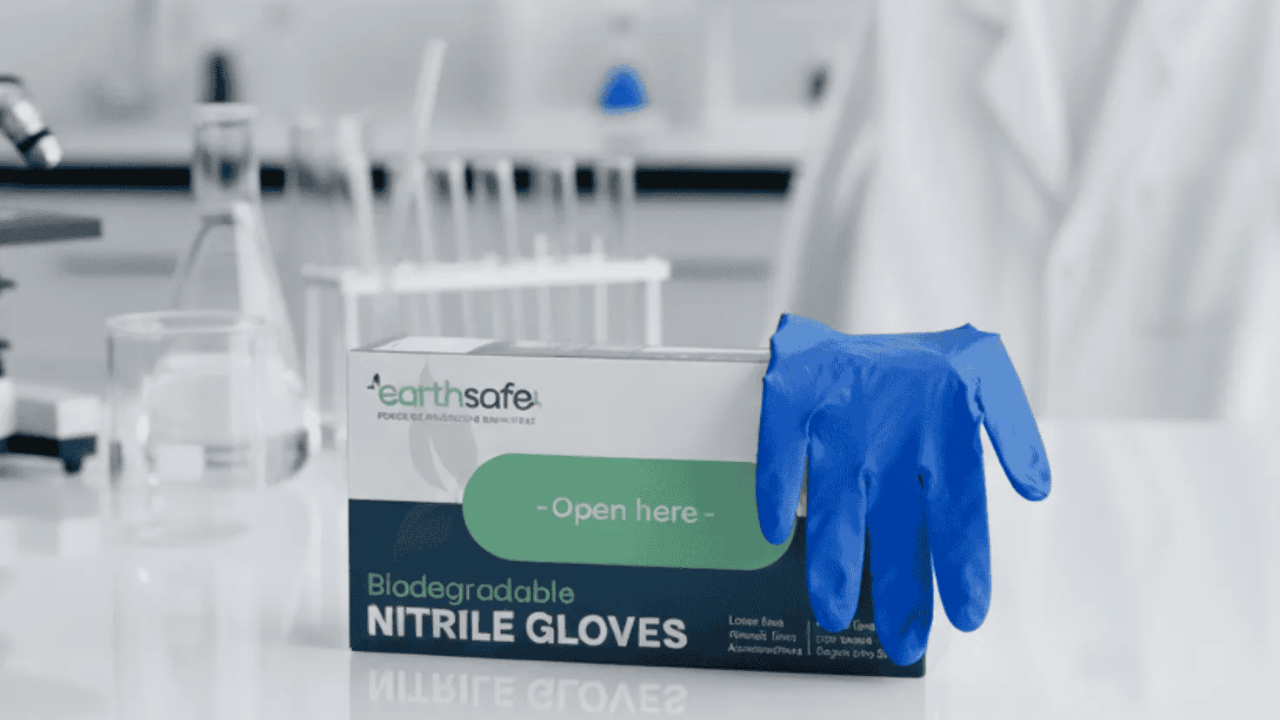
Earth Safe BDG nitrile gloves, for example, are engineered to break down efficiently in active landfill conditions while retaining the mechanical qualities required for regulated settings. Their breakdown rate, up to 90% in 490 days, offers an advantage for organisations working to minimise environmental impact without giving up dependable performance.
Practical Guidance for Businesses Transitioning to Biodegradable Gloves
Below are measures that support a smooth shift while maintaining compliance:
- Request current test reports demonstrating the glove’s performance.
- Assess tasks to confirm that the glove’s thickness, tensile strength, and chemical resistance meet hazard requirements.
- Check storage areas to maintain recommended conditions and protect shelf life.
- Train staff on correct donning, doffing, and disposal.
- Document supplier certifications so auditors can verify compliance easily.
- Integrate biodegradable gloves into existing waste-stream plans for improved sustainability reporting.
These actions maintain operational consistency while allowing organisations to adopt environmentally progressive equipment.
Biodegradable gloves satisfy OSHA and ISO expectations when they meet the same performance standards as traditional nitrile. Their landfill-breakdown capability does not interfere with workplace use or compliance procedures. Instead, it offers an environmentally positive advantage once the glove completes its job.
Organisations can adopt biodegradable gloves confidently as long as they review testing documents, confirm supplier certifications, and follow standard glove-selection procedures. This allows businesses to strengthen sustainability efforts without compromising reliability, quality, or audit-readiness.
Upgrade your operation confidently! Our FDA-compliant biodegradable nitrile gloves deliver the protection and assurance you need to meet the highest food safety standards, all while providing a simple, positive step toward sustainability. Contact our sales team immediately for verified product certifications and bulk pricing: Call +44 7482 212945 or visit our contact page.