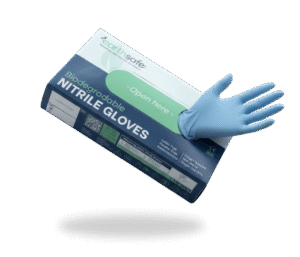

Biodegradable gloves now appear across food service, healthcare, cleaning, and industrial supply catalogs. Packaging often highlights reduced environmental impact, faster breakdown, or landfill-friendly performance. These claims attract interest, but they also trigger doubt. Many buyers ask whether these gloves truly degrade or whether the label is mainly a marketing signal.
This article examines what “biodegradable” means in practice, how claims are tested, and how buyers can separate verified products from unsupported eco-statements. The focus stays on standards, documentation, and observable facts rather than promotional language.
Why skepticism exists
Disposable gloves have long been associated with waste volume and long disposal timelines. Standard nitrile can remain intact in landfill conditions for many decades. Against that backdrop, rapid biodegradation sounds optimistic.
Past experience adds to the doubt. Products marketed as green have sometimes failed to match real-world performance. Vague wording, missing certifications, and selective data have made buyers cautious. As a result, many professionals now demand proof before changing procurement habits.
Skepticism is reasonable. Biodegradability is not a visual feature. It cannot be judged by texture, thickness, or color. Verification depends on standards and test results.
What biodegradable means in a glove context
Biodegradable gloves are still made from synthetic materials. In most cases, the base polymer remains nitrile. The difference lies in additives introduced during manufacturing. These additives allow microorganisms in landfill conditions to access and consume the polymer chains over time.
This process does not mean the glove dissolves quickly or disappears in open air. Breakdown requires specific conditions. Heat, moisture, and microbial presence all affect the rate. Without these factors, even biodegradable nitrile behaves much like standard nitrile.
The claim, therefore, is conditional. A glove can be biodegradable under defined circumstances without breaking down in all environments.
The role of certification standards
Credible biodegradability claims rely on recognized testing methods. One of the most cited standards for nitrile gloves is ASTM D5511.
ASTM D5511 measures biodegradation under high-solids anaerobic digestion conditions. These conditions are designed to simulate biologically active landfills. The test tracks methane and carbon dioxide output as microorganisms consume the material. Results are reported as a percentage of material converted over a set period.
A common benchmark cited in the market is up to 90% biodegradation within approximately 490 days under ASTM D5511 conditions. This figure refers to carbon conversion, not physical disappearance.
Certification matters because it applies the same testing framework across products. Without it, claims lack a shared reference point.
What ASTM D5511 does not claim
ASTM D5511 does not state that gloves compost at home. It does not imply suitability for garden soil or marine environments. It also does not mean gloves vanish after disposal.
The standard focuses on controlled landfill-like conditions. Products tested under ASTM D5511 are evaluated in sealed systems with regulated temperature and microbial activity. Real landfills vary widely, so timelines may shift.
Understanding this distinction prevents disappointment and misinterpretation. Biodegradable does not equal instant or universal breakdown.
How fake eco-claims appear
Unverified eco-claims often share patterns. Packaging may use broad terms such as “eco,” “green,” or “planet-friendly” without referencing any test method. Percentages may be quoted without stating conditions or standards. Some labels mention “additive technology” without data.
Another red flag is selective comparison. Statements like “breaks down faster than regular gloves” provide no timeframe or measurement basis. Faster could mean months, years, or decades.
Buyers should treat these signals as prompts for further checks rather than final proof.
How to verify biodegradability claims
Verification starts with documentation. Reputable suppliers provide third-party test reports or certificates that reference specific standards. ASTM D5511 should be named directly, not implied.
The report should identify the tested material, test duration, and percentage of biodegradation achieved. Dates matter. Old reports may not reflect current formulations.
Clear alignment between the product sold and the product tested is also required. Brand names, material descriptions, and batch references should match.
If this information is unavailable, skepticism remains justified.
Certifications versus regulatory approval
Biodegradability certification differs from regulatory approval for use. Food handling gloves, for example, must also meet food contact and safety requirements. A glove can biodegrade under landfill conditions and still fail food safety standards if not produced under appropriate controls.
Responsible manufacturers address both sides. They combine biodegradability testing with compliance under agencies such as the FDA or equivalent authorities. This dual approach supports adoption without compromising operational requirements.
Buyers should check both categories rather than viewing biodegradability in isolation.
Misunderstanding compostable and biodegradable
Compostable and biodegradable are often confused. Compostable products are designed to break down within a defined timeframe in composting systems and leave no harmful residue. They are tested under different standards.
Most biodegradable nitrile gloves are not compostable. They are not intended for food waste bins or municipal compost programs. Placing them there can contaminate compost streams.
Clear labeling should state the intended disposal route. Absence of such clarity increases the risk of misuse.
Disposal still matters
Even verified biodegradable gloves should be disposed of correctly. Gloves used in healthcare, laboratories, or chemical handling remain subject to clinical or hazardous waste rules. Biodegradability does not override safety protocols.
For food service or household cleaning, general waste remains the most common route unless local programs state otherwise. Biodegradation then occurs, if conditions allow, within the waste system rather than at the point of disposal.
Understanding this prevents unrealistic expectations and supports proper waste handling.
Performance concerns addressed
Some buyers worry that biodegradable additives weaken glove performance. In practice, certified products are tested for strength, barrier integrity, and chemical resistance before release.
Biodegradability relates to end-of-life behavior, not in-use stability. Gloves are designed to remain intact during storage and use. Breakdown begins only after prolonged exposure to suitable microbial conditions.
This separation between the use phase and the disposal phase is central to responsible design.
Market accountability and transparency
As demand grows, transparency becomes a differentiator. Suppliers that publish test data, explain limitations, and avoid exaggerated language build trust. Those who rely on vague claims risk exclusion from professional procurement.
Procurement teams increasingly include sustainability checks alongside price and performance reviews. Certification references now appear in tender documents and supplier questionnaires.
This trend supports clearer standards across the market.
Making informed decisions
Research continues into materials that degrade under a wider range of conditions while maintaining protective performance. Infrastructure changes may also improve landfill environments that support biodegradation.
For now, verified biodegradable nitrile gloves represent a step rather than a final solution. They reduce persistence under specific conditions and align with broader waste reduction efforts.
Skepticism remains healthy. It encourages better claims, clearer data, and higher standards.
Biodegradable gloves can be genuinely biodegradable when supported by recognized standards such as ASTM D5511. They are not a cure-all, nor are they interchangeable with compostable products.
Buyers should rely on documentation rather than labels. Clear standards, third-party testing, and honest explanations matter more than slogans.
With careful review, biodegradable gloves can fit into responsible procurement without confusion or misplaced expectations.
Upgrade your operation confidently! Our FDA-compliant biodegradable nitrile gloves deliver the protection and assurance you need to meet the highest food safety standards, all while providing a simple, positive step toward sustainability. Contact our sales team immediately for verified product certifications and bulk pricing: Call +44 7482 212945 or visit our contact page.