Procurement conversations are changing. Large buyers are no longer focused solely on price, supply continuity, or basic compliance. Environmental performance now enters the discussion early. For suppliers of disposable gloves, this shift is no longer theoretical. It is visible in tenders, audits, and contract renewals.
Fortune 500 companies and major hospital groups are setting new expectations. They ask direct questions about materials, disposal outcomes, and environmental impact. In many cases, sustainability criteria now sit alongside safety and regulatory requirements, not after them.
This change has practical implications for glove suppliers.
The source of the pressure
Large enterprises operate under public scrutiny. Annual reports, ESG disclosures, and third-party assessment require measurable action. Disposable PPE is part of that assessment. High-volume glove usage creates a clear waste signal, one that is easy for stakeholders to track.
Hospital systems face similar pressure. Many belong to regional or national healthcare networks with published sustainability targets. Waste reduction is a priority area. Single-use items, including gloves, fall under internal review programs aimed at lowering landfill dependency without disrupting care standards.
As a result, procurement teams are asking suppliers for alternatives that align with these goals.
What buyers are asking now
The questions have become more specific.
Can the gloves biodegrade under landfill conditions?
Is there verified data, not marketing claims?
Are certifications available for food safety and medical compliance at the same time?
Does switching materials affect performance or protection levels?
These are not exploratory questions. They are screening tools. Suppliers that cannot answer them clearly are often removed from consideration early in the process.
For resellers, this changes the sales dynamic. The product must stand up to internal review teams, compliance officers, and sustainability leads, all at once.
Why is standard nitrile under review
Traditional nitrile gloves remain widely used for good reasons. They offer chemical resistance, puncture strength, and consistent barrier protection. However, their end-of-life profile is drawing attention.
Conventional nitrile does not break down quickly. Disposal usually leads to incineration or long-term landfill storage. For organisations tracking waste outputs, this becomes a measurable liability rather than an abstract concern.
Large buyers are not necessarily rejecting standard nitrile outright. Instead, they are asking whether better options exist, and whether those options can scale without operational disruption.
The role of biodegradable nitrile
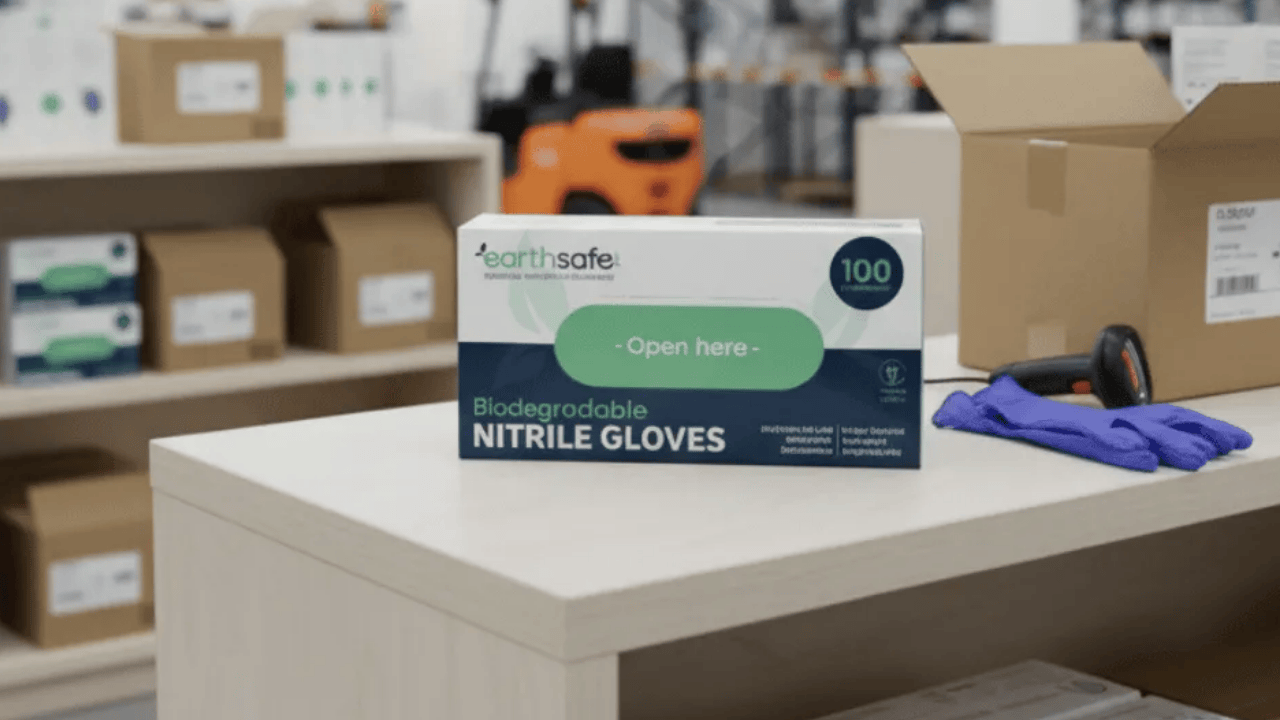
Biodegradable nitrile gloves address this specific gap. They retain the functional properties expected by healthcare and food-handling environments while improving post-use outcomes.
These gloves are engineered to break down more rapidly in landfill conditions, supported by additives that accelerate microbial activity. The result is a measurable reduction in persistence time, without changing how the glove performs during use.
For procurement teams, this matters. It allows them to report progress without introducing new handling procedures or retraining staff. The glove is used the same way. Disposal routes remain familiar. The difference appears later, in waste metrics.
Risk management remains central
Despite the sustainability focus, large organisations do not compromise on protection. Any alternative must meet existing safety standards. FDA compliance, food contact approval, and medical-grade performance are baseline requirements.
This is where some products fail to progress. Sustainability claims alone do not pass internal review. Documentation, test results, and certifications carry more weight than environmental language.
Suppliers that present biodegradable options with verified compliance reduce friction in the buying process. They give procurement teams material they can defend internally.
Budget scrutiny still applies
Cost remains part of the discussion. Sustainable gloves may carry a higher unit price. Large buyers address this by evaluating total impact rather than line-item cost alone.
Waste management expenses, reporting value, and reputational benefits are part of the calculation. Some hospital groups offset higher glove costs through reduced waste penalties or improved sustainability scores tied to funding frameworks.
For resellers, this requires a different sales approach. The conversation moves from unit pricing to operational value. The product supports wider organisational targets, not just task-level protection.
Supply stability and scale
Fortune 500 companies do not test products casually. They require consistent supply, stable specifications, and predictable lead times. Any sustainable alternative must scale across sites without variation.
Biodegradable nitrile solutions that match existing glove formats, sizing, and performance profiles integrate more easily. This lowers resistance during pilot phases and accelerates approval cycles.
Suppliers that can demonstrate readiness at scale gain an advantage. Sustainability alone does not win contracts. Reliability reinforces it.
Internal alignment inside large organisations
One reason demand is increasing is internal alignment. Sustainability teams, procurement departments, and operational leads are now working from shared objectives. PPE selection has become a cross-functional decision.
When these teams agree, change happens faster. Glove suppliers encounter fewer delays when environmental performance supports internal policy rather than conflicting with it.
This alignment is especially visible in healthcare groups managing multiple facilities. A single approved glove specification can roll out across dozens of sites.
What this means for suppliers and distributors
The shift is already underway. Waiting carries risk.
Suppliers that rely solely on traditional nitrile may face longer sales cycles or exclusion from sustainability-led tenders. Distributors without credible alternatives may struggle to retain enterprise accounts.
On the other hand, offering biodegradable nitrile with documented performance creates an opportunity. It positions suppliers as solution providers rather than commodity vendors.
Clear data, simple explanations, and alignment with buyer reporting needs matter more than broad environmental claims.
Preparing for the next procurement cycle
The question is no longer whether top-tier clients will ask about sustainability. Many already are. The real question is how prepared suppliers are to respond.
Product selection, documentation readiness, and sales training all play a role. Resellers need to explain value without overstating claims. Buyers expect clarity, not persuasion.
As procurement standards continue to tighten, glove options that balance protection, compliance, and environmental progress will become standard rather than optional.
Those conversations are happening now.
Upgrade your operation confidently! Our FDA-compliant biodegradable nitrile gloves deliver the protection and assurance you need to meet the highest food safety standards, all while providing a simple, positive step toward sustainability. Contact our sales team immediately for verified product certifications and bulk pricing: Call +44 7482 212945 or visit our contact page.