
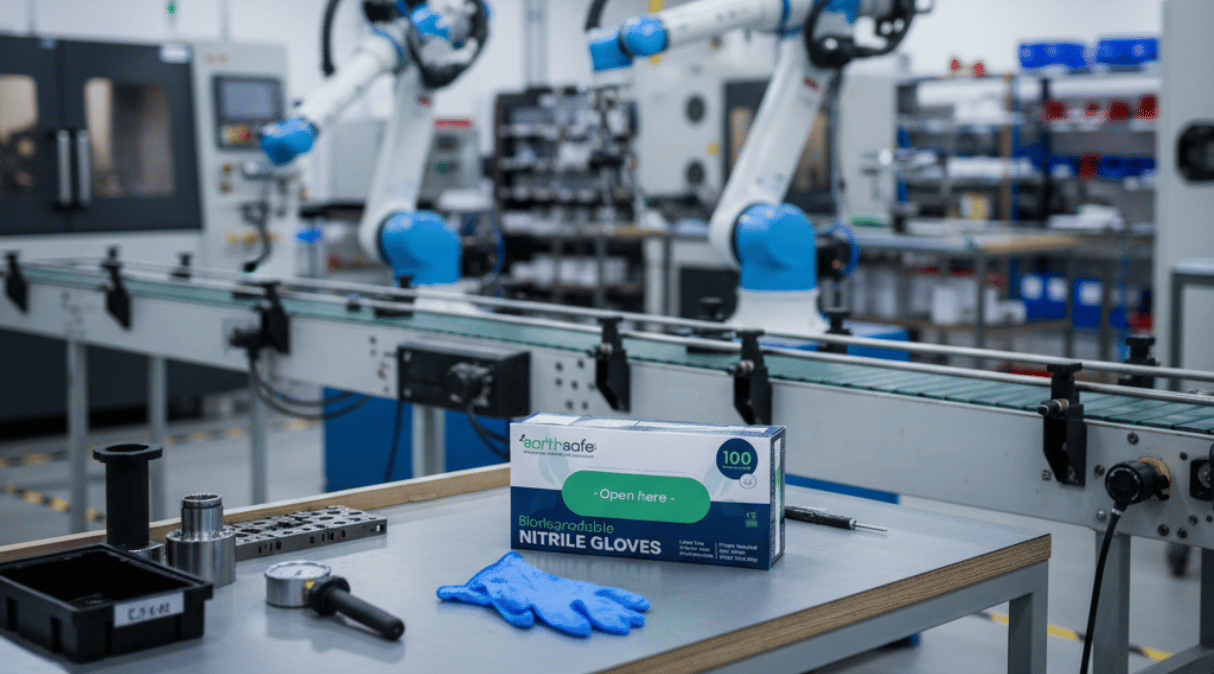
Procurement managers in industrial environments do not have the patience for gloves that fail mid-shift. Chemical resistance is not a preference; it is a baseline requirement. Any product that cannot meet it does not reach the floor, regardless of its sustainability credentials.
So the question is valid: do biodegradable nitrile gloves hold up against the oils, lubricants, fuels, and cleaning agents that define daily operations across manufacturing, food production, and light industrial settings?
The answer requires a clear-eyed look at what nitrile actually does, where biodegradability enters the picture, and what the data shows.
What Nitrile Offers Industrially
Nitrile has been the dominant material in industrial disposable gloves for good reason. It resists puncture, handles a wide range of chemicals, and requires no allergy considerations that latex introduces.
In practical industrial terms, nitrile performs reliably against petroleum-based oils and greases, hydraulic fluids, most cleaning agents and detergents, mild acids and bases, food-grade solvents, and fuels and lubricants common in maintenance work.
This covers the majority of chemical exposure scenarios across general manufacturing, assembly lines, food-adjacent processing, and facilities maintenance.
Standard nitrile does have documented limits. Ketones, acetone, methyl ethyl ketone, break through quickly. Chlorinated solvents such as methylene chloride permeate faster than most users expect. Aromatic hydrocarbons, toluene, and xylene, among them, present a real risk. In these environments, disposable nitrile, biodegradable or otherwise, is not the right material. Butyl or neoprene is a more appropriate choice.
That boundary matters. For the large middle of the industrial spectrum, where standard nitrile already performs appropriately, the relevant question is whether biodegradability changes that performance in any measurable way. Reviewing the known disadvantages of nitrile gloves makes it clear that the limits are material-specific, not unique to biodegradable formulations.
The Core Question Procurement Managers Ask
The most common concern raised by industrial buyers evaluating biodegradable nitrile is straightforward: if the glove breaks down, does that breakdown start during use?
It does not. The mechanism matters here.
Earth Safe PPE’s biodegradable nitrile gloves incorporate an additive that remains completely dormant during storage and use. It does not activate under dry warehouse conditions, moderate temperatures, or standard shift environments. Activation requires sustained microbial activity, conditions that only exist after the glove has been disposed of in an active landfill.
This means the glove behaves identically to conventional nitrile throughout its working life. Tensile strength, puncture resistance, tactile sensitivity, and chemical resistance barrier properties are unchanged. The same physical test standards that govern conventional nitrile apply here. What changes is the end-of-life outcome.
The ASTM D5511 certification is the verification layer. This standard, conducted by independent third parties under anaerobic landfill conditions, confirms the biodegradation data: up to 90% breakdown in 490 days. It is not a manufacturer’s claim; it is a documented test outcome.
Shelf Life: A Specific Concern for Bulk Buyers
Bulk buyers do not purchase boxes. They purchase pallets. A product with uncertain stability represents a supply chain risk that operations leads cannot absorb.
The word “biodegradable” on a carton stored in a warehouse triggers a reasonable instinct: Is this stock going to degrade before it’s used?
Standard shelf life for biodegradable nitrile is three to five years, equivalent to conventional nitrile. Warehouse conditions, controlled temperature, ventilation, low humidity, and minimal microbial activity do not trigger the additive. The dormancy is structural, not incidental. It is how the product is engineered.
A buyer who stocks a six-month supply faces no additional risk compared to standard inventory. The product arrives in the same condition it was manufactured in.
Where the Product Belongs, and Where It Does Not
One of the more credible signals a supplier can offer is an honest use-case scope. Earth Safe PPE’s biodegradable nitrile gloves are appropriate for the broad middle of industrial and manufacturing environments.
Specifically: general assembly and light manufacturing, materials handling, inspection and quality control tasks, food production and food-adjacent processing, maintenance work involving oils, fuels, and lubricants, facilities management, and basic laboratory environments without harsh solvents.
They are not the right product for operations with regular exposure to ketones, chlorinated solvents, or concentrated aromatic hydrocarbons. Buyers in those environments need a different material, and overstating the product’s scope does them no service.
That transparency is worth more to a skeptical procurement manager than a broad claim that the gloves handle everything. Buyers have encountered enough vague eco-marketing to recognise when a supplier is avoiding specifics. The greenwashing problem in PPE supply chains is well-documented, and Earth Safe PPE’s approach, naming limitations directly, separates it from the field.
Addressing the Performance Trade-Off Directly
The intuitive logic that leads many buyers to assume a trade-off goes like this: synthetic durability and biodegradability sit at opposite ends. Increasing one must decrease the other.
That logic applies to materials designed without separation between use-phase and end-of-life behaviour. It does not apply here. The biodegradable additive has no structural role during the glove’s working life. It contributes nothing to barrier properties and takes nothing from them. The two functions operate independently.
Peter and Jakub, who founded Earth Safe PPE with nearly two decades of combined EHS and construction supply experience, built the product specification around exactly this concern. Procurement managers who have lived through PPE failures on the floor know what a glove compromise looks like. The product was designed to offer none.
FDA clearance and accelerator-free formulation add to the picture. The absence of chemical accelerators reduces the risk of skin sensitisation in workers wearing gloves for extended periods, a practical benefit in operations with high daily glove use, independent of the biodegradability question. For operations concerned with meeting OSHA and ISO standards, FDA clearance and third-party certification cover that base directly.
The ESG Pressure Is Real
This product does not exist in isolation from the procurement environment buyers now operate in.
Sustainability obligations have moved from preference to contractual requirement across major industrial supply chains. Fortune 500 manufacturers, large food processing groups, and institutional buyers are asking suppliers about materials, disposal options, and environmental impact with the same directness they bring to safety and regulatory compliance questions.
Glove waste is visible and measurable. High-volume operations generate thousands of pairs per week. Standard nitrile persists in landfill for decades. It fragments. It does not disappear.
Biodegradable nitrile addresses that specific problem without changing the operation. No retraining, no new protocols, no process adjustment. The switch is material, not operational.
For operations managers already dealing with ESG audit preparation, that matters. Tracking scope 3 emissions across supply chains increasingly includes PPE waste as a measurable input. A glove that performs identically but produces a verifiably different end-of-life outcome is a simple, documented step toward increasingly non-negotiable targets.
What Justifies the Cost Difference
Biodegradable nitrile carries a premium over standard options, typically in the range of 15 to 30 percent at low volumes. At scale, that gap compresses considerably. Bulk pricing structures shift the per-unit calculation, and waste disposal savings recover additional ground over a contract period.
The internal justification challenge is structural: the person tracking ESG outcomes is rarely the person approving the spend. Procurement sits between both. The arguments that work with an ESG lead, verified breakdown data, and scope 3 contribution, are not the same ones that work with finance. Finance needs cost projection, risk mitigation, and contract exposure analysis.
The relevant costs to factor in: avoided regulatory risk as plastic restrictions tighten, reduced PPE audit exposure, and waste disposal costs that compound at high glove volumes. At the right scale, the operational math shifts.
Buyers who have run the numbers for operations exceeding 50,000 pairs per month typically find the premium easier to justify than initial resistance suggests.
Verification and Documentation
Industrial procurement does not run on trust. It runs on documentation.
Earth Safe PPE supplies certifications by standard number, ASTM D5511, FDA 21 CFR, not vague eco-labelling. Batch traceability is part of the standard sales engagement, not something offered on specific request. AQL ratings are available.
For buyers navigating multiple compliance frameworks, food safety audits, chemical safety SDS requirements, ESG reporting, and purchasing policy compliance, documentation that arrives in a structured format rather than scattered across supplier emails carries real operational value.
Pilot orders before full-volume commitment are available. That pathway allows procurement to validate the product on its own floor before locking in volume.
A Practical Assessment
Biodegradable nitrile gloves offer the same chemical resistance as conventional nitrile across the vast majority of industrial applications. The sustainability additive does not compromise barrier performance, does not activate during storage, and does not alter the working life of the product in any measurable way.
Third-party certification confirms the end-of-life claim. The use-case boundaries are honest; some chemical environments require a different material, and this product is not positioned for those.
For procurement managers in general manufacturing, food production, facilities management, and maintenance-heavy operations, the switch involves no operational disruption and produces a documented improvement in end-of-life outcomes that increasingly appears in ESG reporting requirements.
The product works. The data is verifiable. The operational case is clear.
Upgrade your operation confidently! Our FDA-compliant biodegradable nitrile gloves deliver the protection and assurance you need to meet the highest food safety standards, all while providing a simple, positive step toward sustainability. Contact our sales team immediately for verified product certifications and bulk pricing: Call +44 7482 212945 or visit our contact page.