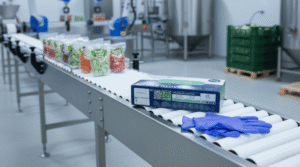

Assembly lines move fast. Gloves get pulled, stretched, pressed against sharp edges, and exposed to oils, light chemicals, and friction, repeatedly, across long shifts. When a procurement manager considers switching to biodegradable nitrile, the first question is not environmental. It is operational. How long do they actually last?
That question deserves a direct answer.
What the Performance Data Shows
Biodegradable nitrile gloves, when properly formulated, match standard nitrile in the metrics that matter on the floor. Tensile strength in fresh biodegradable gloves has been recorded at 34.6 MPa, above the 30.8 MPa typical of conventional nitrile. Puncture resistance is comparable. Barrier integrity under mechanical stress holds within similar tolerances.
The biodegradation mechanism works through microbial activity in landfill conditions after disposal. It does not activate during use. A glove sitting in a storage box or worn on the line does not begin breaking down. The material behaves as standard nitrile would for its entire working life.
This distinction matters. Concerns about gloves degrading mid-task are not supported by the available data on properly certified products.
Lifespan on the Line
Single-use nitrile gloves, biodegradable or standard, are designed for task-based replacement, not hourly timesheets. On an assembly line, replacement frequency depends on the nature of the work.
Light handling, inspection, and materials movement allow longer wear per pair. Contact with abrasives, sharp components, or heavier chemicals shortens it. This is not specific to biodegradable variants. The same rules apply to any disposable nitrile glove.
Where biodegradable options sometimes fall short is in formulations not built for industrial use. Lower-grade products on the market do tear faster under repetitive mechanical strain. This has fed the perception that biodegradable gloves are inherently weaker. The issue is not the biodegradation additive; it is the base glove quality.
Specifying a product with verified ASTM certifications removes that variable.
Shelf Life and Storage
Bulk buyers should account for storage duration. Standard nitrile gloves typically carry a shelf life of three to five years under proper conditions. Some biodegradable formulations show reduced tensile performance after six months or more in storage, depending on humidity and temperature exposure.
This has practical implications for operations that buy in volume and hold stock. Procurement teams should request shelf life documentation alongside performance certifications. A supplier that cannot provide both is worth questioning.
Earth Safe PPE, founded by Peter and Jakub, both with nearly two decades of combined EHS and construction industry experience, operates on exactly this principle. Transparency in product data is not a marketing claim for them. It is the basis of how they work with large-scale clients.
Where the Real Concern Lies
The more substantive concern in industry discussions is not durability during use. It is whether biodegradability claims hold up at all.
A number of products marketed as biodegradable rely on additives that accelerate fragmentation without genuine microbial breakdown. The result is microplastic residue, not decomposition. This exposes buyers to greenwashing risk, a growing compliance concern for organisations with ESG reporting obligations.
Earth Safe’s biodegradable nitrile gloves are certified to ASTM D5511, which tests anaerobic biodegradation under landfill conditions. The gloves biodegrade up to 90% within 490 days in those conditions. That figure comes from standardised testing, not marketing language.
For procurement managers managing sustainability audits, the certification trail matters as much as the product itself.
Cost and Volume Considerations
Biodegradable nitrile sits at a price premium over standard options. That gap narrows at volume, and it shifts further when waste management costs are accounted for. Assembly operations discarding thousands of gloves weekly contribute to landfill weight and, in some jurisdictions, associated disposal fees.
Reduced long-term waste volume is a measurable output, not an abstract benefit. It feeds directly into carbon reduction reporting and operational cost analysis.
The argument for switching is not purely environmental. It is financial and reputational, particularly for manufacturers supplying into markets where supply chain sustainability is now part of the vendor qualification process.
What Operations Teams Should Verify
Before switching, three things are worth confirming with any biodegradable glove supplier.
First, ask for ASTM or EN certification documentation. Review it independently. Second, request shelf life data and clarify storage conditions. Third, run a controlled pilot. One production line, one shift pattern, tracked against current glove consumption. Real-world data from your own floor is more useful than general claims.
S Tyres, one of Earth Safe’s clients, ran exactly this kind of trial before committing. Their managing director confirmed the gloves met operational requirements and held up to factory-floor use. That is the level of verification worth seeking before a bulk commitment.
The Practical Position
Biodegradable nitrile gloves, from a quality-certified supplier, perform on the assembly line at a level comparable to standard PPE. Durability is not an obstacle when the product specification is right. The variables affecting lifespan, task type, storage conditions, and product quality are the same as those affecting any disposable glove.
The difference is what happens after the shift ends. A glove that performs the same during use but contributes significantly less waste over its disposal lifecycle is a straightforward operational upgrade.
Upgrade your operation confidently! Our FDA-compliant biodegradable nitrile gloves deliver the protection and assurance you need to meet the highest food safety standards, all while providing a simple, positive step toward sustainability. Contact our sales team immediately for verified product certifications and bulk pricing: Call +44 7482 212945 or visit our contact page.